
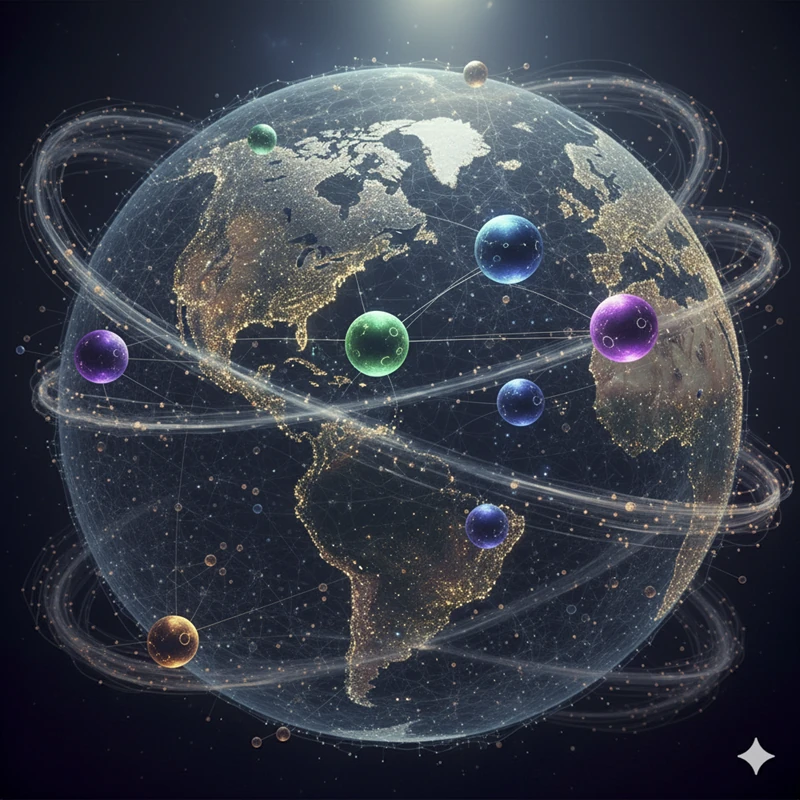
Why agent AI is central to the next generation of online intelligence and automation.
Over the decades, the internet has evolved in layers. First came the document-based web, composed of hyperlinks and static HTML pages. Then came the collaborative web, dominated by social networks that capture our attention. Next arrived the mobile web, which made us even more connected. Now, we are facing something bigger, more structural, and perhaps more transformative, the emergence of the agentic web, an environment in which we are no longer the only ones navigating, comparing, deciding, and purchasing. In this new scenario, autonomous AI agents step in and begin to operate on our behalf.
It’s important to highlight that this future of autonomous agents is not distant. On the contrary, it is already being built through a family of open protocols that began as isolated initiatives but, when observed together, reveal a major movement of convergence and a new architecture for the internet.
Earlier on this blog, we published the article “RAG: The Secret Behind AIs That Truly Understand Your Business”, which explores RAG and frameworks like LlamaIndex, LangChain and CrewAI. These frameworks emerged as a way to enhance responses provided by Large Language Models (LLMs) through more context, specialization, reduction of hallucinations, and most importantly, the ability for LLMs to stop functioning merely as assistants reliant on human prompting and instead gain autonomy in automated processes. More recently, Google launched the Agent Development Kit (ADK), and OpenAI introduced a suite of tools and platforms for building AI agents, including AgentKit, Agent Builder, and the OpenAI Agents SDK. In other words, the race to provide frameworks for creating AI agents is fierce, with many options emerging.
Next, we published the article “MCP: the protocol that’s reshaping the way AI connects to the world” which presents the MCP (Model Context Protocol), developed by Anthropic in 2024. In that article, MCP was described as a “universal USB port” for connecting AI models to real systems, APIs, databases, applications, repositories, and more. It is the layer that allows an AI assistant to stop being just a text generator and become an autonomous AI agent capable of operating the digital world in a secure and contextualized way.
To this foundation we add two additional standards, the ACP (Agent Communication Protocol), developed by IBM and BeeAI, and A2A (Agent-to-Agent), developed by Google, both discussed in the article “Agent Communication Protocol (ACP) and Agent-to-Agent (A2A): The New Communication Language for AI Agents”. In that article, we explained these protocols as the “WhatsApp” and the “corporate Slack” of AI agents, technologies that allow different AI systems to communicate regardless of the framework in which they were built, the cloud they run on, or the type of task they execute. They enable cooperation among intelligences, forming distributed networks of agents capable of coordinating tasks, delegating responsibilities, and solving complex problems together.
Although all these articles are highly technical, they reveal profoundly important trends. It is precisely this communication capability, combined with MCP’s ability to access tools, that is inaugurating the next chapter of the internet. And it was in e-commerce that all these components were orchestrated into a real-world function, introducing a new concept of digital commerce.
This concept was presented in the whitepaper “How Artificial Intelligence Is Impacting Retail Media in Brazil”, developed by the IAB Brasil cross-industry Retail Media + AI working group, of which I was part. There, we see the birth of “agentic commerce,” powered by another ACP, the Agentic Commerce Protocol, created by OpenAI and Stripe. This ACP connects agents directly to stores, catalogs, and checkouts. The document explains how this technology allows an agent to discover a product, recommend it, and complete the purchase without the user opening a browser, an app, or even a traditional shopping cart. Everything happens within the conversation itself, with checkout integrated into the AI model, in this case, within ChatGPT.
This marks a turning point. If MCP connected the agent to the world, and ACP/A2A/AP2 connected agents to one another, then the Agentic Commerce ACP connected the economy to this new layer. The shopping Journey, once filled with clicks, intermediary pages, filters and forms, now collapses into a linguistic exchange.
The IAB Brasil whitepaper interprets this phenomenon within a broader context, the transition to “hybrid intelligence,” in which humans and machines share the decision-making process, and the emergence of GEO (Generative Engine Optimization), which redefines how brands and retailers position themselves within generative ecosystems. Competitive advantage no longer depends on clicks, it depends on algorithmic selection, meaning becoming the option an agent recommends when it interprets intent, context, and availability.
When we combine all this, a new type of consumer emerges, what the whitepaper calls the “algorithmic consumer.” It is no longer the person navigating across tabs but their agent, operating with speed, precision, and volumes of data far beyond human capabilities.
This transition signals an even deeper transformation, one that has been predicted for Years, the “death of the Internet.” Not in the conspiratorial sense, but in a functional one. The internet will be increasingly less browsed by humans and increasingly traversed by machines, machines that search, summarize, compare, negotiate, and execute on our behalf. Content will be read by agents and created for agents. Transactions will be optimized by agents and influenced by recommendation agents. For the first time, we are building an agentic web in which machines are direct users.
There are immense benefits in this process, more fluid journeys, decisions contextualized in real time, operational efficiency, continuous personalization, and coordination between systems that were once isolated. But there are also risks, algorithmic opacity, data concentration, ethical vulnerabilities, platform dependency, and a new competitive layer, one no longer between brands and consumers, but between brands and the agents making decisions for those consumers.
The agentic web is not merely a technological evolution; it is a structural reorganization of the decision-making flow. MCP, ACP, A2A, AP2, the Agentic Commerce ACP, and GEO are not scattered pieces or an alphabet soup, they are the architecture of the next phase of the internet. A phase in which intelligence and action merge, and in which to compete is to influence the systems that increasingly choose on our behalf. Beyond the attention economy, we are witnessing the rise of the algorithmic choice economy. And the question is no longer “how do we influence people?” but rather: how do we influence the agents who represent them?