

Explore how social media conversations shaped the Oscars 2026. Data reveals audience reactions, engagement peaks, and the moments that drove the biggest online buzz.
The Oscars remain one of the most culturally visible events in global entertainment. But beyond the red carpet and the awards themselves, the ceremony generates a massive digital footprint across social media platforms.
A recent analysis of online conversations between March 1 and March 15, 2026, reveals how audiences interact with the Oscars in real time, what moments drive engagement, and which films and personalities capture the most attention. The data shows that the Oscars are not just a television broadcast. They are a distributed digital event, where audience reactions unfold simultaneously across multiple platforms.
The scale of the oscars conversation online
The magnitude of the conversation surrounding the Oscars highlights the event’s ability to mobilize audiences globally. During the analyzed period, online discussions generated:
- 906 million mentions
- 356K unique authors
- 2 billion reach
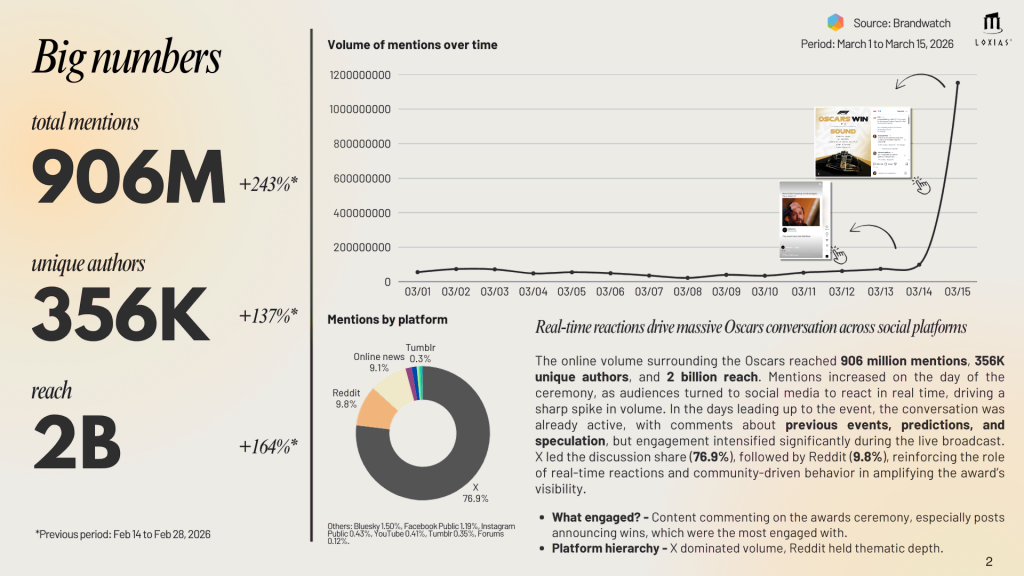
Engagement peaked during the ceremony itself, when audiences turned to social media to react to the winners and key moments in real time. While discussions were already active in the days leading up to the ceremony, the live broadcast created a sharp spike in activity, confirming the role of the Oscars as a real-time cultural event.
Platform dynamics: where the conversation happens
The analysis reveals a clear hierarchy between platforms when it comes to Oscars discussions. X (formerly Twitter) dominated the conversation, accounting for 76.9% of total mentions, making it the primary space for real-time reactions. Other platforms contributed in different ways:
- Reddit (9.8%) hosted deeper community discussions
- Online news (9.1%) extended coverage through media outlets
- smaller platforms contributed marginally to overall volume
This distribution reflects how audiences consume live cultural events today: fast-paced reactions occur in real-time networks, while community platforms provide deeper interpretation and commentary.
Sentiment around the Oscars: mostly positive engagement
The general sentiment toward the ceremony was favorable. The event reached a Brand Health Index of 7.02, representing a 14% increase compared to the previous period, placing the Oscars firmly within the “Good” perception range.
Sentiment distribution showed:
- 46% positive mentions
- 40% neutral mentions
- 14% negative mentions
Positive engagement was largely driven by celebratory reactions to major wins, particularly the recognition of actor Michael B. Jordan, whose victory generated a high volume of enthusiastic posts. While negative discussions were comparatively limited but were amplified by controversy surrounding comments made by Timothée Chalamet, which triggered criticism across social media.
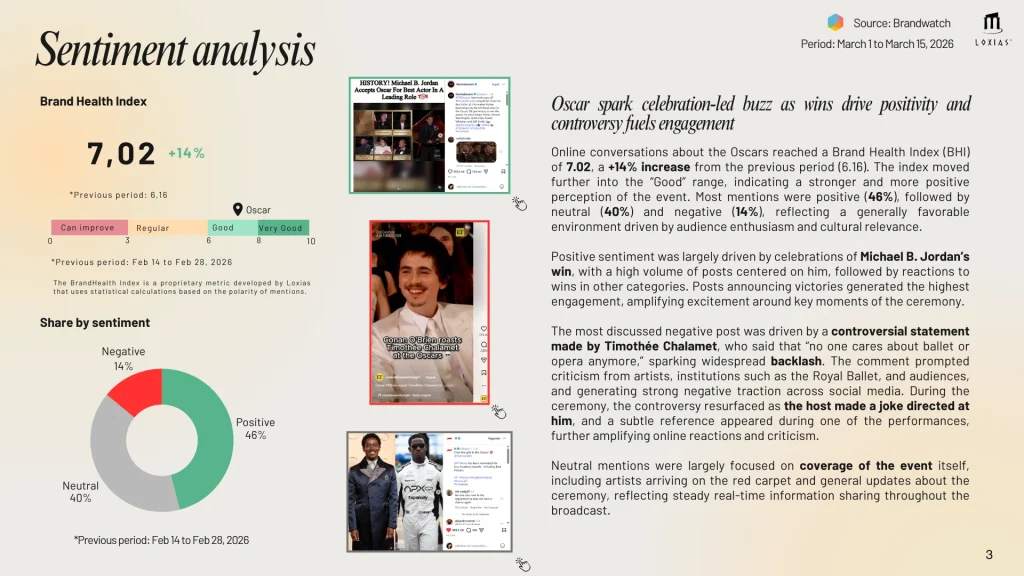
This combination of celebration and controversy illustrates a key characteristic of digital culture: engagement often increases when emotional reactions, both positive and negative, are triggered simultaneously.
The films and creators who captured the most attention
Not all nominees receive equal visibility in the digital conversation. The film Sinners dominated the discussion, capturing over 40% of mentions among nominated films and establishing itself as the central point of attention during the awards cycle. The film also made history with 16 nominations, the highest number ever recorded for a single title.
Behind it, films like One Battle After Another and Hamnet maintained a secondary presence, while the remaining nominees formed a long tail of limited visibility. This pattern illustrates how digital attention often concentrates around a few leading contenders once momentum builds.
The “winner effect” in social media conversations
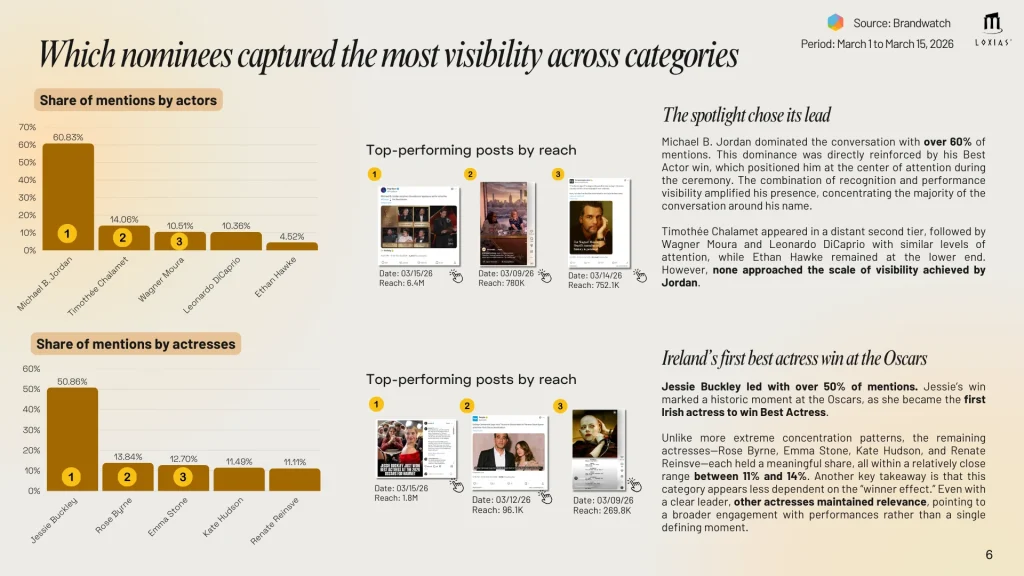
The analysis also reveals a powerful phenomenon: the winner effect. When awards are announced, attention rapidly consolidates around the winning individual or production. Recognition instantly translates into visibility dominance. For example: Michael B. Jordan captured over 60% of actor-related mentions, following his Best Actor win. In the Best Director category, Ryan Coogler led the conversation with nearly 59% of mentions, significantly outpacing other nominees.
This concentration of attention suggests that digital audiences respond strongly to moments of recognition and achievement. Award announcements act as synchronization points, aligning audience reactions in real time.
Categories that drive attention
The analysis of category-level discussions reveals another important insight. Visibility is not distributed evenly across awards categories. On Oscar night:
- Best Picture generated over 72.1K mentions
- Best Actor generated 58.2K mentions
- Best Director generated 33.8K mentions
- Best Actress generated 16.3K mentions
Categories with greater symbolic weight tend to concentrate the largest share of attention, as they represent the perceived “ultimate outcome” of the ceremony. This hierarchy shapes how audiences engage with the event and determines which moments become the focal points of the online conversation.
Business insight: why peak moments matter more than continuous visibility
One of the most important strategic insights from this analysis is that attention during large cultural events does not grow evenly over time. Instead, engagement appears in sharp peaks triggered by specific moments, such as award announcements, historic milestones, or unexpected statements. This pattern suggests that visibility is built less through sustained messaging and more through high-impact moments that mobilize audiences simultaneously.
For brands and media companies, this has several implications:
- real-time content strategies outperform delayed reactions
- posts tied to event milestones generate significantly higher engagement
- participation during peak moments is more effective than continuous coverage
In other words, the value of participating in large cultural events lies in timing and contextual relevance, not simply in volume of content.
How Loxias methodology turns conversations into insights
Understanding complex digital conversations requires more than simple monitoring tools. Loxias combines advanced technology and analytical expertise to transform large volumes of social media data into strategic insights. The methodology integrates: AI-powered social listening platforms, advanced tools capable of capturing and processing large-scale conversations across multiple digital environments, proprietary analytical frameworks, custom methodologies that identify patterns in sentiment, engagement, and narrative structures within online discussions, human expertise from social media analysts and data scientists, specialists who interpret the data, identify emerging narratives, and translate findings into actionable insights for organizations.
Through this approach, Loxias helps brands and institutions understand how public conversations evolve and how cultural events shape audience behavior.
From ceremony to cultural moment
The Oscars extend far beyond the stage of the ceremony itself. Content related to performances, historic achievements, and viral moments spreads across platforms and communities, reaching audiences that may not traditionally follow the awards. This dynamic transforms the event into a broader cultural catalyst.
Digital participation amplifies the ceremony’s visibility and allows global audiences to engage in real time, turning the Oscars into a shared cultural experience that unfolds simultaneously across the internet.
The future of cultural events in the social media era
The data shows that major cultural events now operate within a hybrid ecosystem where broadcast media and digital platforms interact continuously.
Visibility is shaped by:
- real-time audience participation
- symbolic moments of recognition
- platform-specific dynamics
- global digital communities
In this environment, understanding social media conversations is no longer optional. It is a critical capability for organizations that want to interpret cultural trends, anticipate audience behavior, and participate effectively in moments that capture global attention.
Download the full report here: