
An in depth data driven analysis of Stranger Things 5 shows how audience sentiment evolved from hype to critical evaluation and what this reveals about culture, platforms, and data intelligence.
From hype to debate: a cultural moment under the lens of data
The final season of Stranger Things did not simply premiere. It triggered a global cultural conversation that unfolded across platforms, formats, and emotional registers. By analyzing public conversations between November 9 and December 9, 2025, this report reveals how audience reaction evolved from immediate excitement to a more reflective and demanding evaluation.
This shift matters. It shows how major entertainment launches now live far beyond release day, shaped by participatory culture, platform dynamics, and audience expectations built over years.
Data show scale is instant, relevance is sustained
Data from All Ears highlights the speed and intensity of the initial reaction. In just a few weeks, Stranger Things 5 generated over 10.8K mentions, reached nearly 545 million people, and accumulated USD 28.6 million in PR value. TikTok alone accounted for 71% of mentions, confirming short form video as the primary engine of visibility.
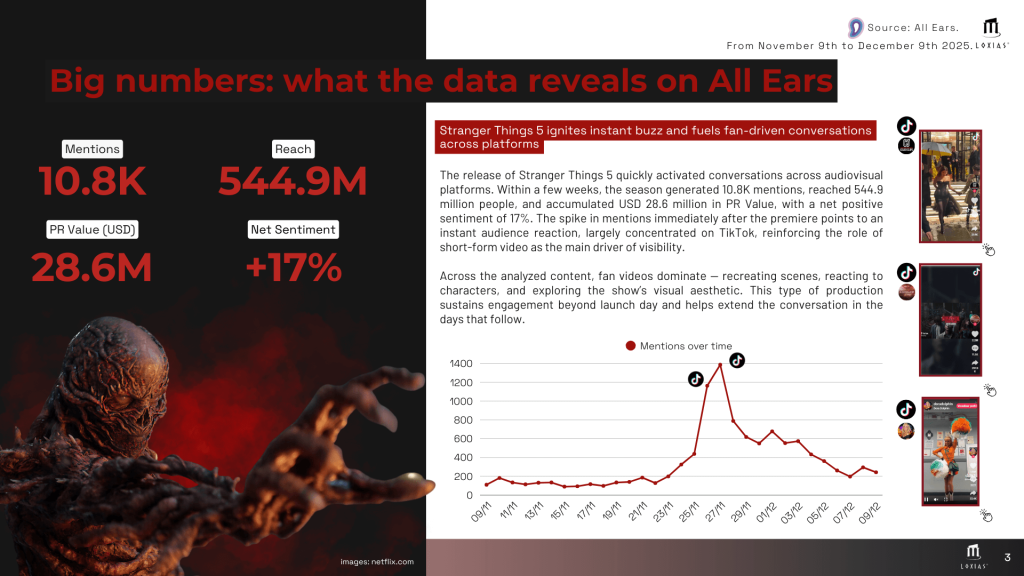
However, reach alone does not explain longevity. Podcasts, responsible for 25% of mentions, played a key role in extending meaning over time. While TikTok captured emotion and immediacy, long form audio added interpretation and context. Together, they sustained relevance well beyond the premiere window.
Data from sentiment analysis: a mature and demanding audience
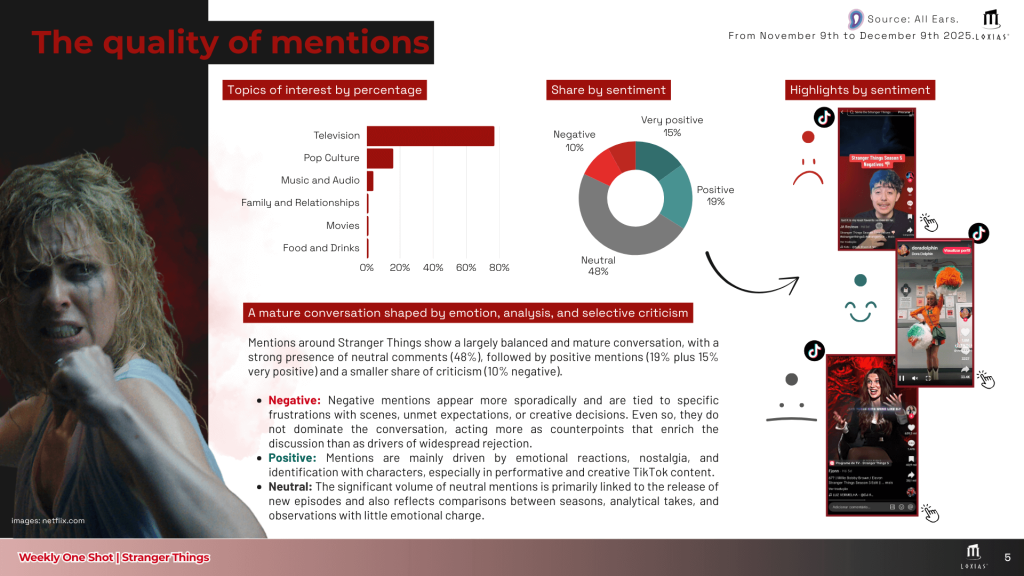
Sentiment analysis shows a conversation that is balanced rather than polarized. Nearly half of mentions were neutral, with positive and very positive reactions outweighing negative ones. This neutrality is not indifference. It reflects an audience that compares seasons, analyzes narrative choices, and engages critically without disengaging.
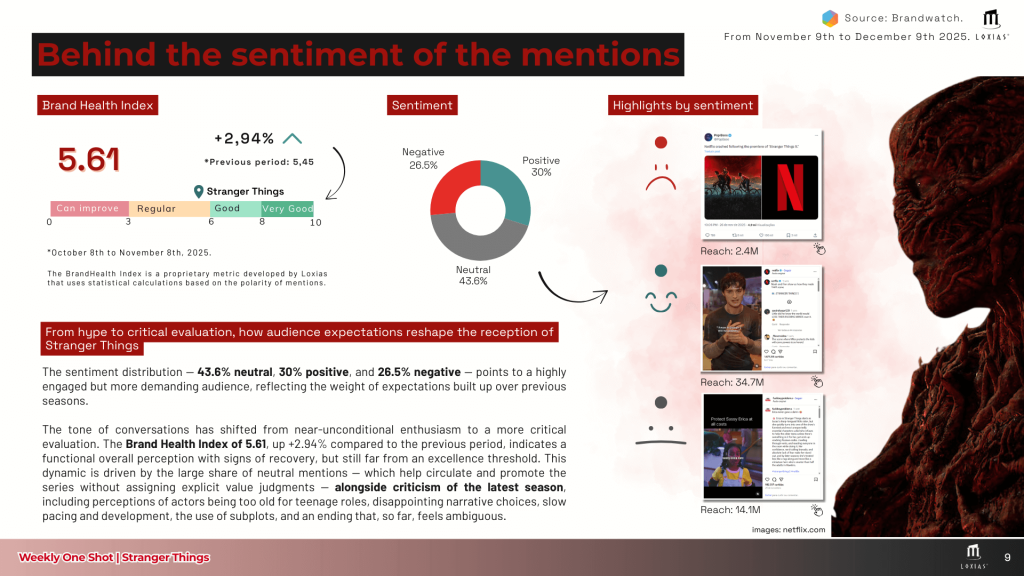
Brandwatch data reinforces this insight. With 1.83 million mentions and 4.9 billion in reach, participation was widely distributed across users rather than concentrated among a few large profiles. The Brand Health Index of 5.61 indicates a functional but demanding perception, shaped by high expectations accumulated over the series’ history.
Data demographics explain the dynamics
Generation Z leads the conversation, followed closely by Millennials. This demographic profile helps explain the dominance of fast, visual, and reactive formats. It also explains why criticism does not weaken engagement. For digital native audiences, critique is part of participation, not a signal of rejection.
Geographically, the conversation is global, with strong presence in the United States, Brazil, the United Kingdom, and India. This reinforces Stranger Things as a shared cultural reference that travels easily across markets and platforms.
What data reveals about modern audience behavior
Three patterns stand out. First, emotional peaks drive visibility, especially on TikTok. Second, analytical and neutral content sustains discussion over time. Third, criticism and praise coexist, reinforcing relevance rather than canceling it.
For brands and content creators, the implication is clear. Cultural impact today is not measured only by applause. It is measured by how long and how deeply people keep talking.
Data intelligence at the core: how Loxias AI reads culture
Understanding these dynamics requires more than volume metrics. This is where data intelligence becomes strategic. Loxias AI combines multi channel monitoring, proprietary methodologies, and human expertise to translate raw conversation into actionable insight.
In this report, data intelligence made it possible to connect sentiment trends with platform behavior, demographic profiles, and narrative drivers. Instead of treating mentions as isolated signals, Loxias AI contextualizes them within culture, expectations, and time.
This approach allows leaders to anticipate shifts in perception, identify early signs of fatigue or renewal, and understand how audiences truly relate to brands and stories. Data intelligence, in this sense, is not about prediction alone. It is about interpretation with depth and clarity.
From data to leadership insight: from entertainment to strategy
Stranger Things 5 shows that relevance is no longer guaranteed by scale. It is earned through continuous engagement, emotional resonance, and openness to critique. Leaders who understand this can apply the same logic beyond entertainment, to brands, products, and reputations.
The real lesson of this analysis is not about a TV series. It is about how culture behaves when audiences feel invested, heard, and empowered to respond.