
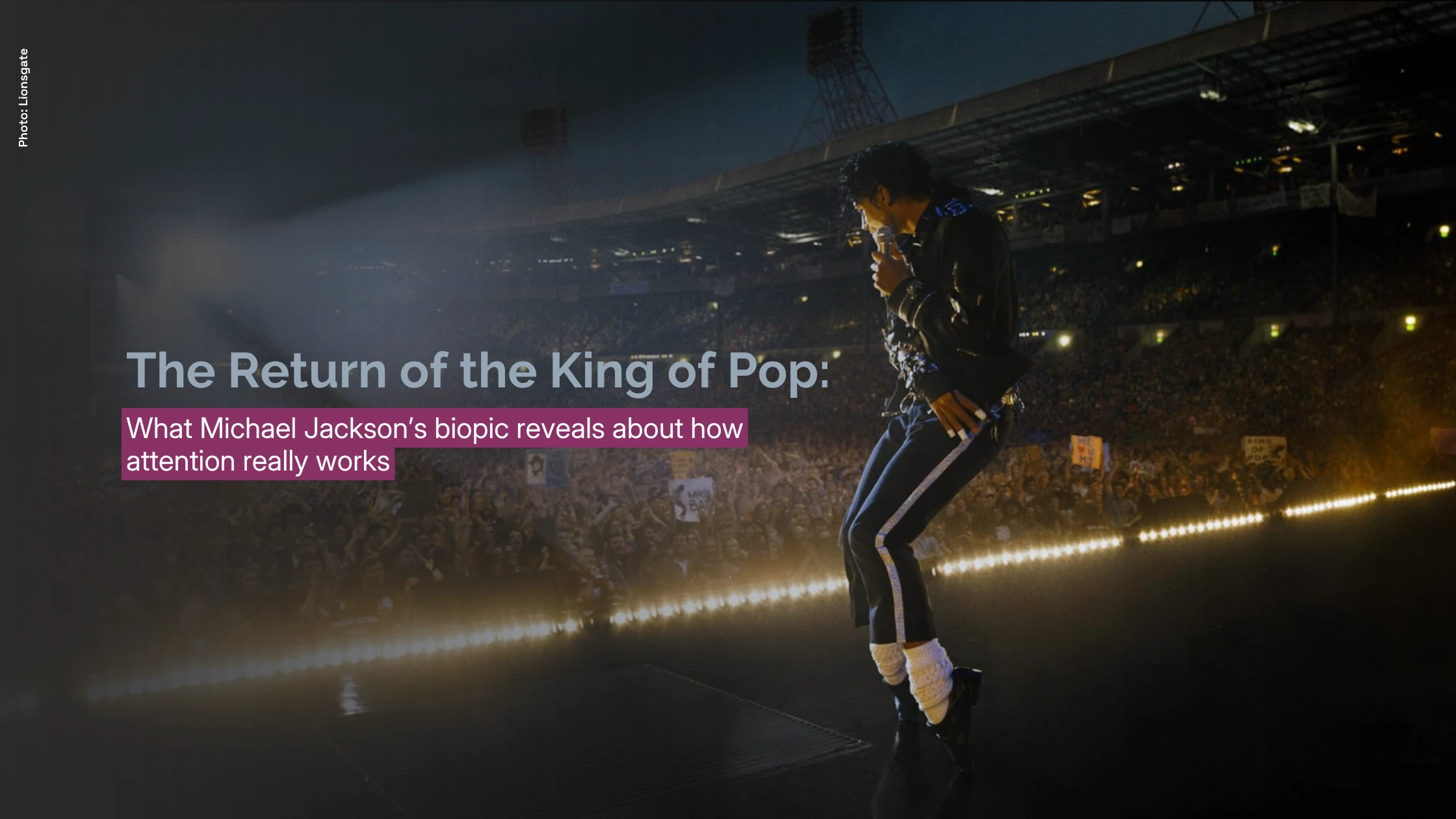
An analysis of how the Michael Jackson’s biopic Michael became a cultural event, driven by fans, podcasts, TikTok, and cross generational attention.
Analysis period: January 21 to April 21, 2026
Data sources: Brandwatch, All Ears, and Glimpse
Language analyzed: English mentions
There are film releases, and then there are cultural events. Michael Jackson’s biopic, Michael, belongs firmly in the second category. The data makes that clear in ways that go far beyond view counts and ticket pre sales.
Over the three months leading up to the film’s premiere on April 24, 2026, Loxias AI tracked the conversation across social platforms and audio content. What emerged was not a simple promotional wave. It was something more layered, more revealing, and more useful for anyone trying to understand how attention is built and sustained in the digital era.
A conversation that grew organically and never really stopped
The numbers are significant on their own. In the January to April window, the film generated 25,000 mentions across TikTok, YouTube, and podcasts, with a combined reach of 314.7 million and an estimated PR value of $102.3 million. Net sentiment landed at +13%, suggesting a broadly positive reception before audiences had even seen the full film.
But the real story sits beneath those numbers.
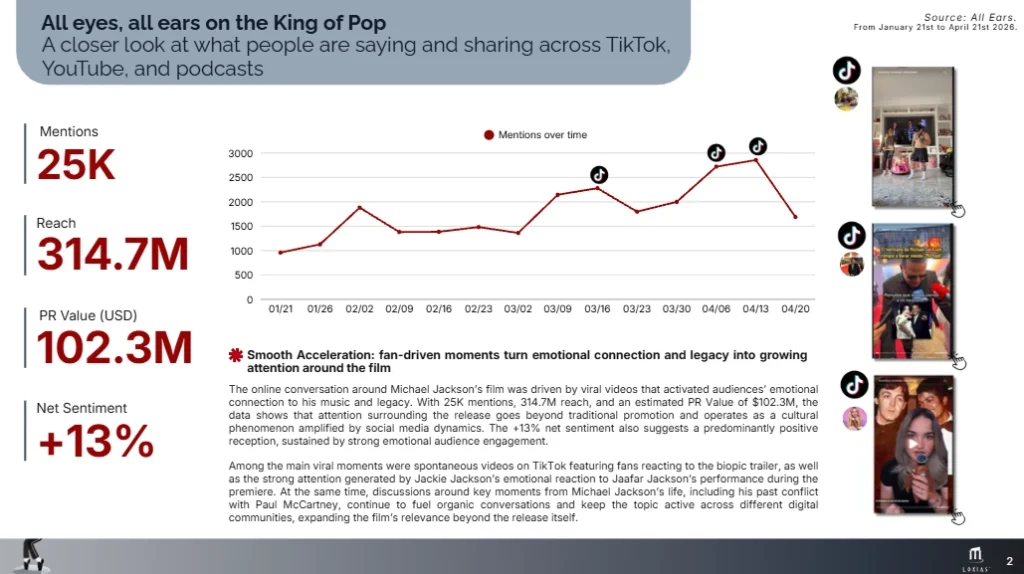
Attention did not arrive in a single promotional burst and then disappear. It grew gradually, dipped, and then rose again as the premiere approached. That pattern aligns more closely with genuine audience anticipation than with manufactured hype.
The main driver of early momentum was not the official campaign. It was the fans. Spontaneous TikTok reaction videos, especially around the trailer release, created an emotional pull that institutional marketing alone could not generate. One moment stood out in particular: Jackie Jackson’s public reaction to his nephew Jaafar’s performance at the premiere created its own wave of attention, drawing in people who may not have been closely following the film before.
These are not the dynamics of a standard product launch. They are the dynamics of a cultural moment.
Where the conversation lived and why that matters
The platform breakdown tells a story that may surprise anyone who equates social media attention with TikTok alone. Podcasts accounted for 58% of total mentions, compared with 26% for TikTok and 17% for YouTube.
That distribution points to something important. The Michael Jackson biopic was not just generating viral clips. It was generating longer, more substantive conversations.
Podcasters and commentators were spending time with the story. They were exploring Jackson’s legacy, debating his controversies, and questioning what the film chose to include or leave out. The most recurring terms reflected that depth: “jackson,” “biopic,” “movies,” “trailer,” and “premiere,” along with broader markers such as #michaeljackson, which show how the conversation expanded outward from the film and reconnected with the artist’s broader cultural presence.
TikTok played a different but equally important role. It drove visibility and emotional immediacy. It was the platform where attention caught fire, even if podcasts and YouTube were the channels that sustained it.
The official trailer reinforced that picture. It generated 116.2 million views in its first 24 hours, surpassing the previous record held by the Taylor Swift: The Eras Tour teaser at 96.1 million. For a biopic about an artist who died in 2009, that level of immediate attention is not automatic. It reflects a mix of genuine cultural relevance and smart amplification.
Sentiment was not uniformly positive, and that is part of the story
On X, Brandwatch data showed a more nuanced sentiment picture than the All Ears audio analysis. The Brand Health Index reached 7.61 out of 10, up 15.13% from the previous period and well within the “good” range. Sentiment distribution came in at 39% positive, 50% neutral, and 11% negative.
That polarization is not a weakness, it is revealing.
Critics focused on what the production did not address: the controversies and complexities that shaped Michael Jackson’s public life as much as his musical legacy. The film’s celebratory tone, centered on performance and spectacle, was seen by some as an appropriate tribute and by others as a missed opportunity for a more honest portrait.
This tension showed up clearly in the conversation. People were debating the line between tribute and biography, and between honoring a legacy and interrogating it. That kind of tension helps explain why the conversation remained durable. When a film sparks real disagreement around questions that matter, it tends to stay in circulation long after opening weekend.
One point of consensus did emerge. Across both positive and critical commentary, Jaafar Jackson’s performance was repeatedly identified as the production’s strongest source of legitimacy. His ability to recreate Michael’s physicality, gestures, and stage presence earned widespread praise. Given that Jaafar is Michael’s real nephew, had never acted before, and prepared for the role in near total secrecy for more than two years, that recognition carries real weight.
Who is talking and from where
Audience data adds another layer to the analysis. Millennials led the conversation at 47.31%, followed by Gen Z at 38.55%, while Gen X accounted for 14.14%. The United States represented the largest share of attention, with notable participation from the United Kingdom, Nigeria, and Canada.
The gender split leaned male at 62%. Topics of interest clustered around sports, family and parenting, music, and books. That suggests an audience driven not only by fandom, but also by identity, entertainment, and cultural memory.
The generational overlap matters.
Millennials are engaging through emotional memory. They grew up with Michael Jackson’s music and experienced his peak cultural presence firsthand. Gen Z is engaging through a different mechanism, shaped by the viral logic of social media, digital aesthetics, and the rediscovery of older cultural icons through platforms like TikTok.
That creates a rare situation in which the same cultural object means different things to different audiences, yet both groups are participating in the same digital conversation. The film is working simultaneously as a commemorative experience and a discovery experience.
The reach architecture behind 2.2 billion
On X, the conversation operated at a much larger scale. Brandwatch data captured 1.6 million mentions and 2.2 billion in reach, with 426,300 unique authors generating 499.1 million total impressions.
What matters most is how that reach was built.
The biggest spike arrived with the trailer release in early February, when reach briefly approached 120 million in a single period. After a natural decline, attention began climbing again as the premiere approached, fueled by final trailer drops, premiere activity, and the first wave of audience reactions.
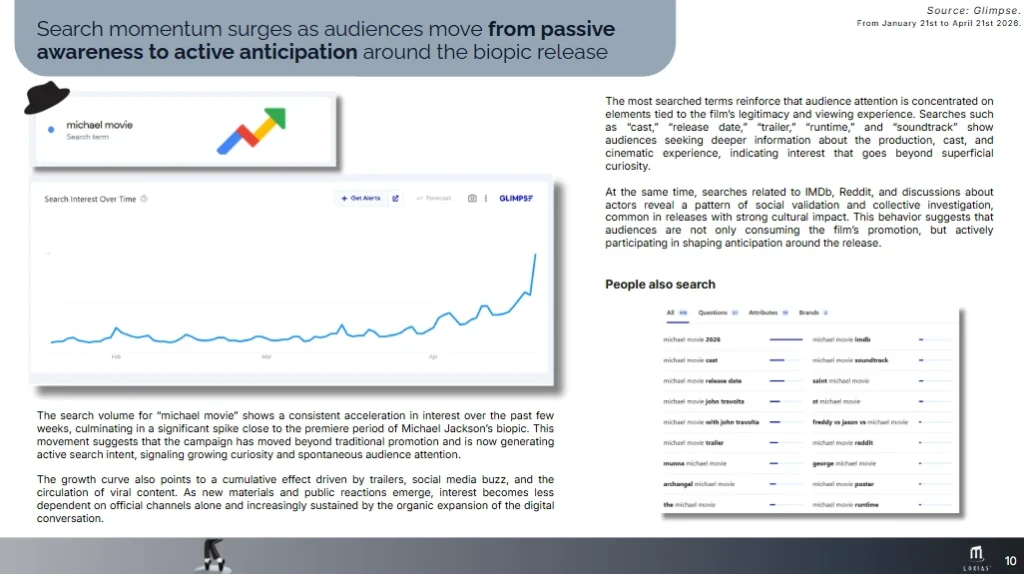
The highest reach content came from both official and organic sources. Universal Pictures India and Lionsgate Movies drove major volume through institutional campaigns. But organic content added the emotional depth that official promotion alone could not supply. That included Taj Jackson’s commentary on narrative ownership and the emotional response surrounding the film’s official trailer.
Taj Jackson’s post is especially instructive. By directly addressing who gets to control the narrative of Michael Jackson’s story, he reached 2 million people on its own. This kind of content changes the stakes of a conversation. It invites audiences not just to watch, but to care.
What the data predicted and what comes next
Viewed through a forward looking lens, several patterns stand out.
Glimpse search data showed consistent acceleration in search volume for “michael movie” from February through April, ending in a significant spike just before the premiere. Search behavior focused on signals of legitimacy and viewing intent, including cast, release date, runtime, soundtrack, IMDb scores, and Reddit discussions.
That pattern is typical of releases with real cultural stakes. Audiences were not passively absorbing marketing. They were actively building a case for why the film deserved their attention.
The predictive signals in the data suggest that post release conversation will continue to be driven by the same tension that shaped the pre release phase. The debate between tribute and authenticity is unlikely to be settled by opening weekend reviews alone. It is more likely to continue across podcasts, YouTube essays, and long form digital commentary for months, or even years.
For the entertainment industry, the implication is clear. A film with this kind of cultural weight requires a more sophisticated intelligence approach than view counts and sentiment dashboards can offer. The real strategic value lies in understanding which narratives are gaining traction, which audiences are amplifying them, and where the conversation is likely to move next.
The momentum around Michael was not accidental. It was built through a combination of cultural relevance, emotionally resonant organic content, and an audience that arrived already invested. The data shows how that combination works. The open question for studios and brands is how to create the conditions for this kind of attention, and how to sustain it once it appears.
Where intelligence becomes strategy
This analysis was built from social media intelligence: structured data collection, cross platform monitoring, and the interpretive layer that turns numbers into decisions.
At Loxias, that is the core of the work. We help organizations understand what is actually happening inside digital conversations, not just what surface level metrics appear to show.
In a case like the Michael Jackson biopic, a purely quantitative reading might stop at reach and sentiment. The real intelligence starts with deeper questions. Why is podcast volume outpacing TikTok if TikTok is driving visibility? What does it mean that the most durable narrative tension centers on tribute versus authenticity? How should a distributor respond to that tension after release? Which organic voices are shaping perception more than the official campaign, and what are they actually saying?
Those are not questions that can be answered with a dashboard alone.
They require integrating data from multiple sources, applying proprietary frameworks to map narratives and audience behavior, and translating that understanding into strategic direction.
Loxias acts as a strategic partner for organizations at different stages of intelligence maturity. Our work combines social media intelligence with integrated datasets, automation, and human expertise grounded in culture, context, and business decision making.
If your organization is navigating a release, managing a cultural moment, or trying to understand how narratives around your brand are taking shape, this is the type of work we are built to do.
Download the full report here: