
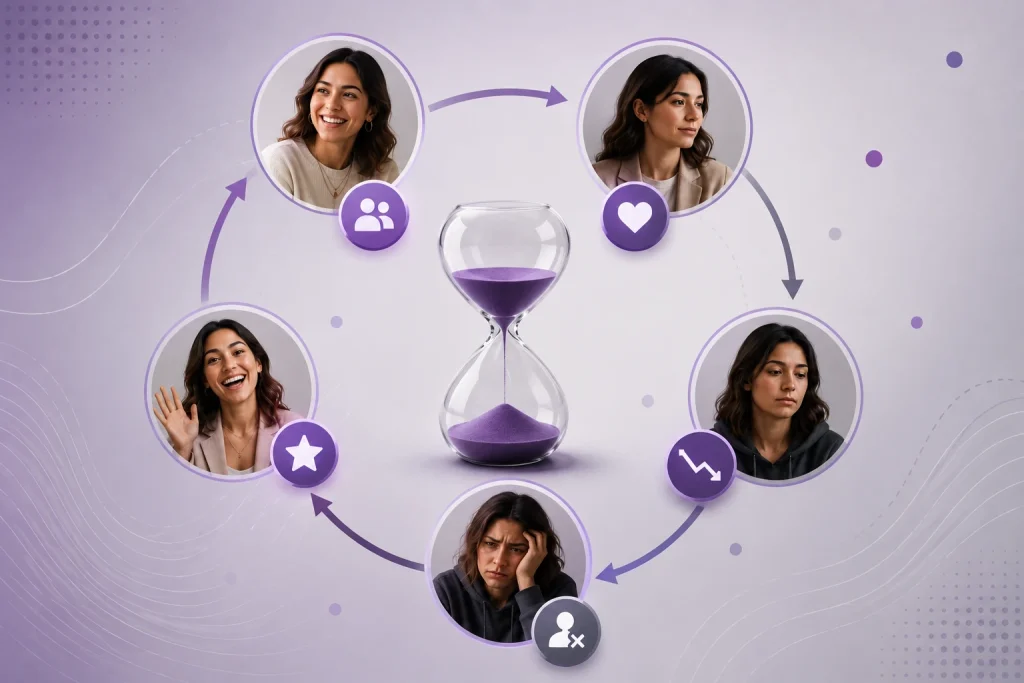
The same influencer playbook does not work across every platform phase. Find out how to diagnose where your community stands and adapt your strategy accordingly.
Platforms and communities change phases. A strategy that works in the beginning can fail when the environment matures.
Marketing teams tend to repeat familiar formulas. When a brand grows fast on a platform, the temptation is to apply the same logic to another one. When a creator partnership delivers results, the next plan usually tries to reproduce that model.
The problem is that social networks, digital communities, and influence ecosystems do not stay still. They change pace, consolidate references, create habits, and establish informal rules. What works in one phase can lose force in another.
In the early stages, much is still contested. Over time, certain names become references. At specific moments, shifts in the platform’s normal flow temporarily disrupt the existing order: a new format gains priority, a key creator shifts topics, a trend displaces the conversation, a competitor campaign pulls attention, a seasonal date alters audience behavior.
That is why influence should not be treated as a fixed formula. It depends on the current state of the network, the maturity of the community, and the position the brand holds within the conversation.
The takeaway is direct: there is no influence strategy without a diagnosis of the moment.
The three most common phases
1. Nascentearly-stage phase: when positions are still open
At the beginning of a platform, community, or conversation territory, it is not yet clear who the main references are. Norms are forming, groups are organizing, and there is more room for experimentation.
For brands and creators, this is a valuable phase. Entering early allows relationships to be built before the cost of attention rises. The work is less about large campaigns and more about presence, listening, consistent participation, and understanding the local culture.
2. The consolidation phase: when hubs gain strength
After some time, the community recognizes who the important names are. Users follow already-established references, algorithms reinforce profiles with strong response rates, and conversations begin to revolve around a few centers.
In this phase, starting from scratch becomes harder. Publishing more is not enough. It is necessary to understand who organizes the conversation, which communities already exist, and which relationships provide legitimate access to the territory. Partnerships, collaborations, and trust-building carry more weight.
3. The adjustment phase: when a change opens a short window
Sometimes, a common shift in everyday life alters the pace of the network. It may be an algorithm update, a new feature, a fast-growing trend, a competitor campaign, a statement from a relevant influencer, or a change in audience behavior.
In these moments, old habits are questioned and some positions reorganize. But the window tends to be short. Those who observe quickly can learn and position themselves. Those who wait too long find the new order already stabilized.
What this changes in planning
The first question should not be “which platform is trending right now?” It should be: what phase is the community we want to operate in?
If the environment is nascent, the focus should be on learning, participating, and building presence before saturation sets in.
If the environment is consolidated, the focus should be on mapping hubs, understanding local codes, and building relationships with those who already hold trust.
If the environment is in an adjustment phase (outra op: disruption phase), the focus should be on speed of reading. The goal is not to rush into any available space, but to identify which conversations are shifting and where the brand can enter with legitimacy.
This diagnosis helps avoid a common mistake: applying the same framework to different environments. A new platform does not behave like a mature one. An expanding community does not behave like a stable one. A moment of disruption does not behave like routine.
The line worth keeping: influence has a lifecycle
In the beginning, the opportunity lies in arriving early and learning. During consolidation, it lies in connecting to the right hubs. During adjustment moments, it lies in quickly recognizing what has changed.
For social listening, this means looking beyond mention volume. What matters most is understanding how attention is organizing itself: who is gaining centrality, who is losing force, which groups are drawing closer, and which conversations are no longer depending on the same names.
The best playbook is not a reapplied formula. It is the one that fits the current phase of the network.