

Explore what social conversations around TikTok Shop reveal about creator commerce, product discovery, consumer trust and the evolution of social commerce in 2026.
Shopping online used to begin with a fairly clear intention. A consumer needed something, searched for it, compared a few options and eventually made a purchase. TikTok Shop is making that sequence much less predictable.
Products now appear while people are watching videos, following creators, joining livestreams or simply scrolling through content. Discovery can happen before purchase intent exists, and the distance between seeing something interesting and buying it can be reduced to a few taps.
That shift is visible in the scale of the conversation. Between January 1 and October 5, 2026, TikTok Shop generated around 191,000 mentions, reached 241 million people and involved approximately 76,000 authors in the analyzed social conversation. Those numbers are useful, but the more interesting question is what people are actually discussing. The answer offers a closer look at how social commerce is developing, where brands are finding opportunities and which parts of the shopping experience still create friction.
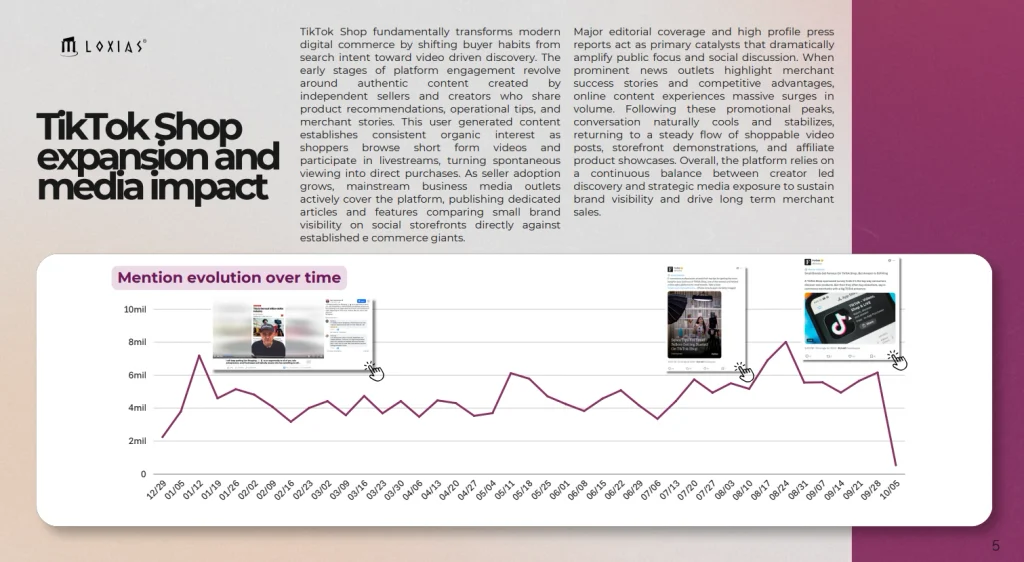
TikTok Shop is changing how product discovery happens
One of the clearest patterns in the data is the growing connection between entertainment and commerce.
Consumers do not necessarily enter TikTok with a product already in mind. They encounter products through creator recommendations, demonstrations, livestreams, comparisons and trends, often within the same content they were already consuming for entertainment. TikTok Shop effectively compresses several stages of the customer journey into one environment. Awareness, consideration, social validation and purchase can all happen within the same session. This matters because product discovery becomes less dependent on traditional search behavior.
The platform creates opportunities for brands to appear earlier in the decision process, sometimes before the consumer has actively identified a need. Social commerce therefore introduces a different type of competitive environment. Visibility depends not only on whether a product can be found, but also on whether it can become relevant inside the content people already choose to watch.
Creators are becoming part of the commercial infrastructure
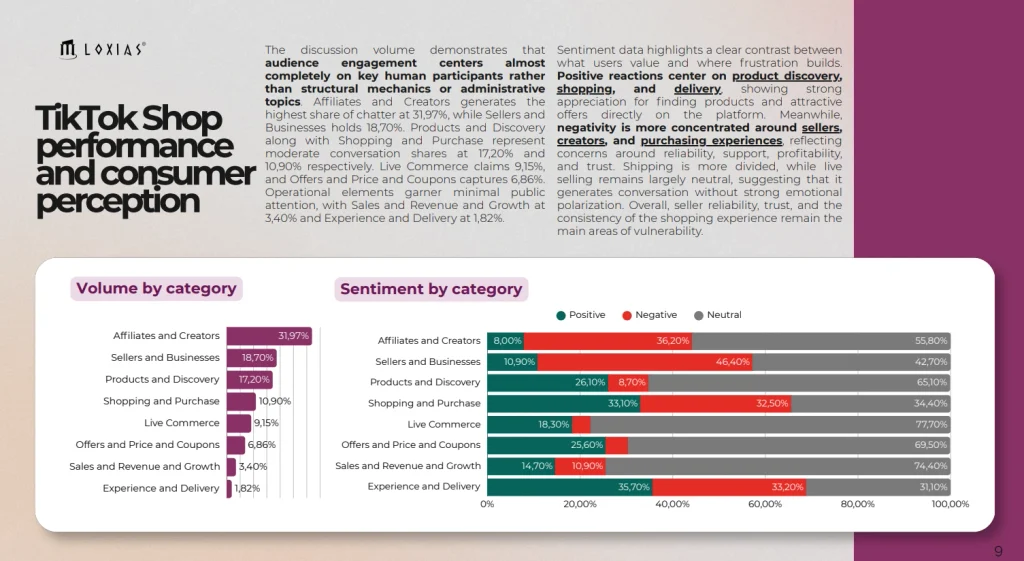
Creators and affiliates account for 31.97% of the conversation analyzed around TikTok Shop, making them the largest discussion category in the study. Sellers and businesses represent another 18.70%, while products and discovery account for 17.20%. That distribution suggests that creators are playing a role that goes beyond awareness.
They demonstrate products, explain how they work, compare options and provide a form of social validation before purchase. In many cases, the person introducing the product is also helping the consumer evaluate it.
For brands, this changes the logic of creator partnerships. The value of a creator may increasingly depend on their ability to make a product understandable and credible, rather than simply exposing it to a large audience. A tutorial, comparison or detailed product demonstration can answer questions that would traditionally be handled by product pages, search results or reviews. In this environment, content becomes part of the shopping experience itself.
Discovery performs well, but trust remains a critical part of the journey
The sentiment analysis provides another important clue. Products and discovery show a comparatively positive profile, with 26.1% positive sentiment and only 8.7% negative sentiment. Shopping and purchase is more divided, with 33.1% positive and 32.5% negative conversation.
Seller-related discussion is more challenging. Conversations about sellers and businesses show 46.4% negative sentiment, reflecting concerns related to reliability, support and the broader marketplace experience. The platform can be highly effective at generating interest. The harder part begins once consumers start evaluating whether they trust the transaction. Search behavior reinforces this point.
People are not only looking for promo codes, coupons or seller tools. Searches also include questions such as whether TikTok Shop is safe or legitimate, alongside demand for customer service information. This suggests that trust is already part of the conversion process.
Seller verification, product authenticity, delivery expectations, return policies and accessible customer support can directly influence whether interest becomes a completed purchase.
Discounts still play an important role in social commerce
Price remains another visible driver of attention. Across video and audio conversations, recurring terms include discounts, coupons, shipping, deals and prices, alongside product discovery language and hashtags associated with viral purchases. This makes sense within the TikTok Shop environment. A consumer may discover a product unexpectedly, and an immediate discount can provide the additional incentive required to complete the purchase.
However, promotional incentives work within a broader decision context. A discount can accelerate conversion, but consumers are still evaluating whether the seller is trustworthy, whether the product appears authentic and whether the purchase will arrive as expected. The strongest commercial experience therefore combines discovery, credible content, clear value and confidence in the transaction.
Established brands are entering the same environment
TikTok Shop is also becoming increasingly relevant beyond independent sellers and creator businesses. The conversations analyzed in 2026 show established brands and retailers participating more actively, particularly through beauty, fragrance, electronics and live shopping initiatives. This creates an interesting environment for larger organizations.
TikTok Shop offers access to a form of discovery that is strongly influenced by cultural relevance and creator participation. At the same time, established brands enter the platform with existing expectations around reputation, customer experience and brand consistency. Success therefore depends on more than simply listing products.
Brands need to understand how their products enter social conversations, which creators make them credible, what questions consumers raise and where hesitation appears before purchase. That is where social intelligence becomes particularly useful.
What social intelligence can reveal about TikTok Shop
Analyzing TikTok Shop solely through sales or engagement metrics provides only part of the picture.
Social conversations help explain the context behind those outcomes. They can reveal which products are gaining attention, how consumers describe them, what creators are influencing purchase consideration, which promotional mechanics generate interest and where concerns begin to appear.
They can also show how different parts of the experience are perceived. For example, a brand may see strong product engagement while conversations simultaneously reveal concerns about authenticity or delivery. Another product may have modest conversation volume but unusually positive creator advocacy.
Those distinctions matter because the same commercial result can emerge from very different consumer dynamics. Social intelligence adds another layer to the analysis by connecting volume with narrative, sentiment, behavior and context.
Key insights for brands exploring TikTok Shop
Several implications emerge from the 2026 conversation.
1. Creator selection should consider credibility as much as reach
Creators can function as product validators. Content that shows how a product works, compares alternatives or explains its limitations can help consumers move from curiosity to confidence. For brands, this means evaluating creator partnerships through the quality of the relationship they have with their audience, the relevance of their content and their ability to communicate product value clearly.
2. Trust signals belong closer to the moment of discovery
Consumers are actively checking whether the platform, seller or product can be trusted. Information about authenticity, delivery, returns and customer support should therefore be easy to access before checkout. These details may appear operational, but they can influence conversion directly.
3. Social commerce requires closer observation of the entire purchase experience
Discovery may be creator led, while dissatisfaction can emerge later through shipping, seller support or product quality. Brands should therefore monitor conversation beyond campaign performance. Tracking how discussion evolves from product discovery through post purchase experience can reveal where enthusiasm is being maintained and where friction begins to appear.
4. High visibility does not always mean broad influence
The analysis also shows how reach can become concentrated around a relatively small number of high profile creators and celebrity collaborations. Individual examples in the report reached audiences in the millions, including content associated with Dolly Parton, Ice Spice and Beauty Creations Cosmetics.
Large reach can create rapid exposure, but brands should still examine what happens underneath that visibility: who engages, what is being discussed and whether attention develops into meaningful product interest.
5. TikTok Shop should be treated as a source of consumer intelligence
The platform produces continuous evidence about how people discover products, evaluate recommendations, respond to pricing and discuss trust. Those conversations can help inform creator strategy, product communication, retail experience, customer support and competitive analysis. The value is not limited to understanding what performed well. It can also help explain why.
From social discovery to a more complete commerce experience
TikTok Shop is bringing several elements of digital commerce closer together. Entertainment creates the initial context. Creators introduce and validate products. Discounts can accelerate consideration. Checkout removes friction from the transaction.
The remaining challenge is consistency. The same speed that makes social commerce attractive also raises expectations across authenticity, delivery, support and the overall purchase experience.
The 2026 conversation suggests that consumers are already evaluating all of these elements together. Brands that understand those conversations can see more than whether TikTok Shop is generating attention. They can understand what is creating demand, what is building confidence and what may prevent a spontaneous discovery from becoming a repeat purchase. For organizations trying to understand the next phase of social commerce, that context may be just as valuable as the transaction itself.
Want the full picture?
The patterns explored here are only part of what the full analysis reveals about TikTok Shop, creator influence, consumer trust and purchase behavior.
Download the complete TikTok Shop: The New Era of Social Commerce report to explore the data, category breakdowns, sentiment analysis and strategic recommendations in more detail.