
Discover how K-beauty dominates the global skincare conversation. A social media intelligence analysis reveals consumer trends, brand competition, and the growing influence of Korean beauty brands.
The global beauty industry is undergoing a structural shift. Over the past decade, Korean skincare brands have evolved from niche trendsetters into dominant voices in the digital beauty conversation. Today, K-beauty has become one of the most influential movements in the skincare market, driven by highly engaged online communities, cultural influence, and strong social media momentum.
Through the lens of social media intelligence, it is possible to understand how consumer behavior, brand positioning, and digital culture are shaping the future of beauty.
The explosion of the K-Beauty conversation online
The scale of the digital conversation around Korean skincare highlights the growing relevance of the category worldwide.
Across social media platforms, discussions about K-beauty have grown significantly, with hundreds of thousands of mentions and millions of impressions generated over a few months. This growth signals that K-beauty is no longer just a passing trend. Instead, it has become a sustained conversation within the global skincare ecosystem.
Platform distribution reveals where these discussions take place:
- X (Twitter) dominates the conversation, acting as a real-time hub for trends and discussions
- Online news articles extend the topic into mainstream media
- Reddit communities contribute in-depth conversations and peer recommendations
- YouTube and Instagram provide visual demonstrations and product reviews
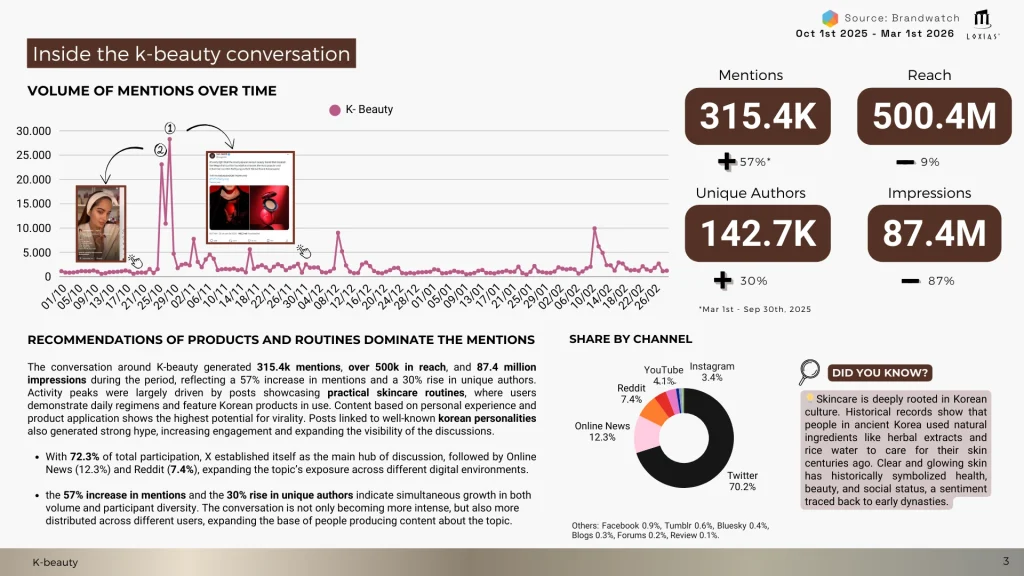
Together, these platforms create a hybrid ecosystem where rapid discussions coexist with educational and visual content.
What drives K-Beauty conversations
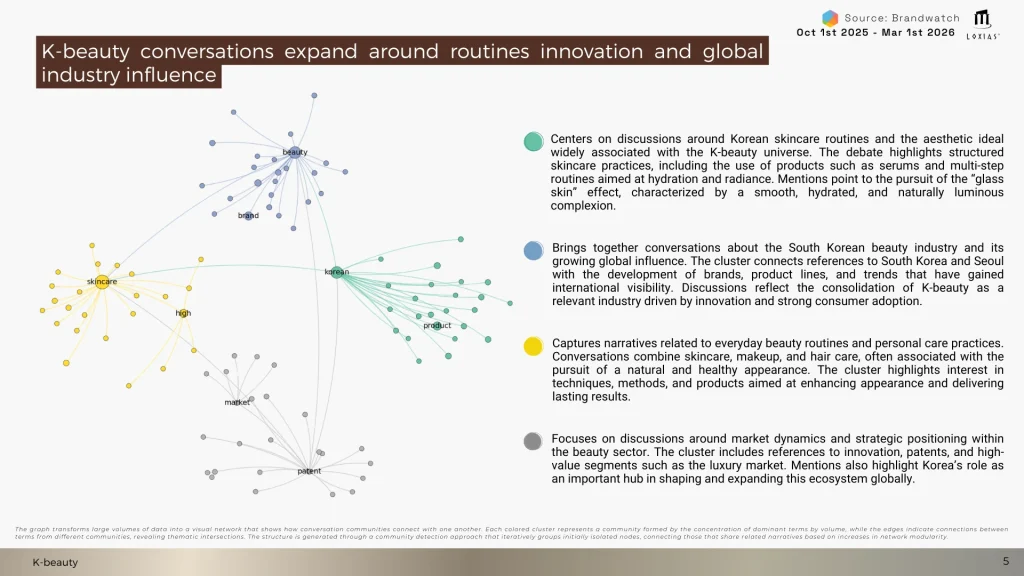
Online discussions about Korean skincare are largely shaped by three major factors: skincare routines, ingredient awareness, and cultural influence.
Skincare Routines and Product Culture: One of the strongest drivers of conversation is the culture surrounding skincare routines. Consumers frequently share their daily regimens, product recommendations, and skincare experiences. As a result, social media platforms function as recommendation ecosystems where users validate products through shared experiences. This peer-to-peer exchange plays a crucial role in shaping purchase decisions.
The “Glass Skin” Aesthetic: A central concept in K-beauty conversations is the pursuit of “glass skin.” This aesthetic ideal emphasizes smooth texture, deep hydration, and a luminous complexion. At the same time, consumers demonstrate growing technical knowledge about skincare ingredients. Discussions often reference compounds such as:
- niacinamide
- hyaluronic acid
- centella asiatica
- advanced skin-repair ingredients
This blend of aesthetic aspiration and ingredient awareness shows how modern skincare consumers seek both emotional appeal and scientific credibility.
Celebrity Influence and Cultural Momentum: Korean pop culture also plays a major role in amplifying K-beauty discussions. Endorsements from K-pop idols and actors create strong waves of online attention. Product launches and influencer collaborations often trigger spikes in social media engagement. This dynamic connects entertainment, lifestyle, and skincare consumption, reinforcing the cultural influence behind Korean beauty trends.
Sentiment around K-Beauty: enthusiasm with critical discussion
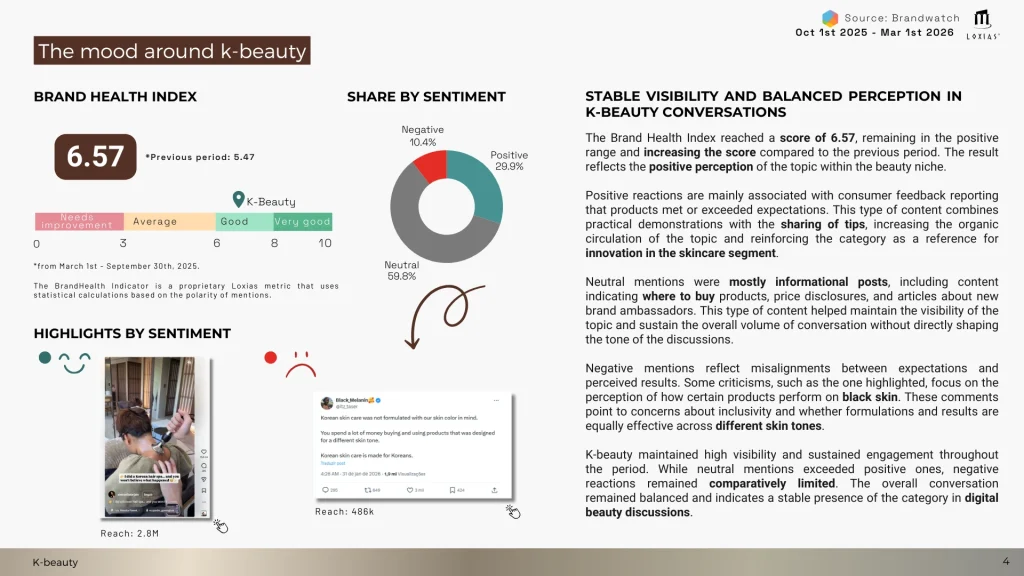
Digital sentiment analysis shows that the perception of Korean skincare remains largely positive. Many users praise the effectiveness of products, especially when visible results are demonstrated through real-world usage. Neutral discussions typically focus on product availability, prices, and brand announcements. Negative comments appear less frequently and usually revolve around broader cultural debates or concerns about inclusivity in skincare formulations. Overall, the online conversation shows strong enthusiasm combined with increasingly informed consumer perspectives.
The brand battle: Korean vs American skincare brands
One of the most interesting insights from social media intelligence is the competitive dynamic between Korean and Western skincare brands. In digital conversations, Korean brands dominate the narrative, capturing the majority of mentions related to skincare innovation and routines.
Leading Korean brands in the conversation: Several Korean brands stand out as central players in the online skincare ecosystem. Among the most discussed are:
- Laneige
- COSRX
- Beauty of Joseon
- Innisfree
- Round Lab
Rather than relying on a single dominant brand, the K-beauty ecosystem operates as a network of recognizable brands that collectively shape the category’s identity.
Western competitors: skincare brands follow a different positioning strategy.
Leading brands in this group include:
- The Ordinary
- CeraVe
- Clinique
- Neutrogena
- Estée Lauder
These companies often emphasize dermatological credibility, ingredient transparency, and clinical effectiveness.
Two different beauty narratives
The contrast between Korean and Western brands reveals two distinct strategic approaches. Korean beauty brands typically focus on: lifestyle storytelling, multi-step skincare routines, cultural influence and entertainment, rapid innovation in product formulations. While western brands tend to emphasize clinical validation, functional ingredients and dermatologist-backed positioning.
Both strategies resonate with consumers, but the storytelling and cultural momentum behind K-beauty have given Korean brands a significant advantage in social media conversations.
User-generated content: the engine behind K-Beauty growth
Another important factor behind K-beauty’s expansion is the power of user-generated content. Many viral posts feature real consumers demonstrating products, showing textures, and sharing personal results. This type of content creates strong social proof and encourages other users to test the products themselves.
Younger audiences play a particularly important role in this dynamic. Gen Z consumers are especially active in sharing skincare routines, product reviews, and ingredient insights across social platforms.
Why social media intelligence matters for beauty brands
With millions of online conversations happening every day, understanding consumer perception requires sophisticated analytical tools. Social media intelligence enables brands to identify:
- emerging beauty trends
- changes in consumer perception
- competitive positioning between brands
- potential reputation risks
By transforming unstructured social data into actionable insights, companies gain a deeper understanding of how digital conversations influence market behavior.
Read more -> How to Discover Beauty Trends with Social Listening and AI
Loxias: Social Media Intelligence for the Beauty Industry
Loxias is a social media intelligence company that helps organizations understand public conversations across digital platforms. Its solutions combine artificial intelligence with expert analysis to monitor social media discussions and identify meaningful patterns in consumer behavior.
Key capabilities include:
Brand Health Monitoring: Continuous tracking of brand perception across social channels.
Competitive Benchmarking: Comparative analysis of how brands are positioned in digital conversations.
Strategic Social Media Reports: In-depth analysis of trends, narratives, and market movements.
The solutions also supports real-time monitoring for sentiment analysis, trend detection, and crisis management. By combining advanced analytics with human expertise, Loxias enables companies to transform social media data into strategic business intelligence.
The future of beauty is being shaped online
The rise of K-beauty illustrates how digital culture now drives market leadership. Its success reflects a powerful combination of innovation, cultural influence, and highly engaged online communities. As beauty brands compete for attention in an increasingly digital marketplace, understanding online conversations will be essential for staying relevant.
In this new environment, social media intelligence is not just a marketing tool. It has become a strategic resource for understanding the future of the beauty industry.The global beauty industry is undergoing a structural shift. Over the past decade, Korean skincare brands have evolved from niche trendsetters into dominant voices in the digital beauty conversation.
Download the full report here: